
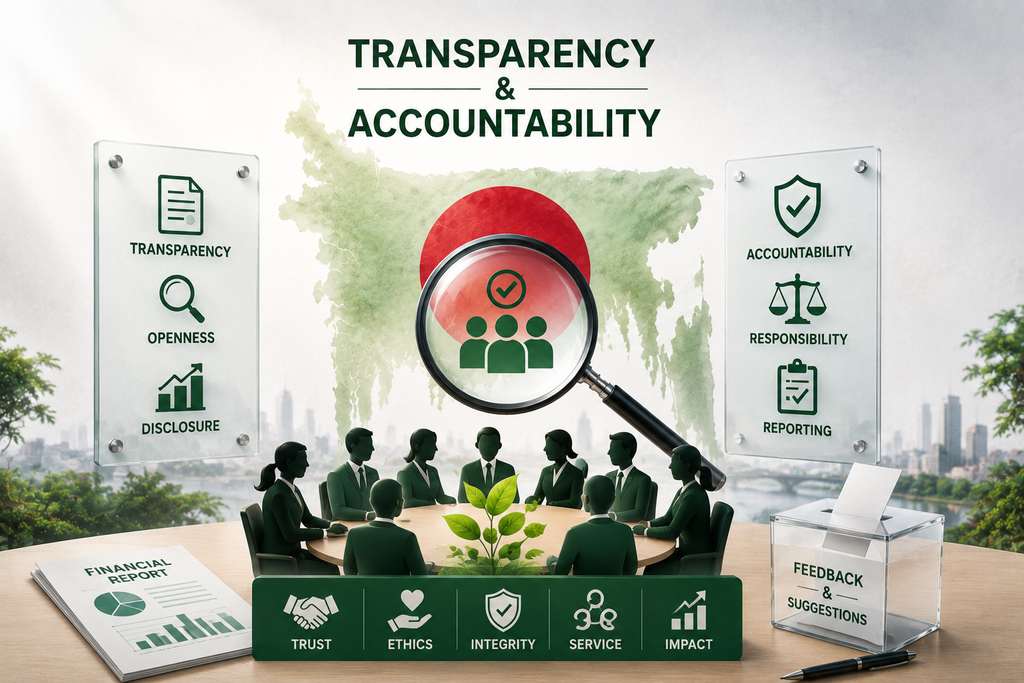
Trust Through Transparency. Responsibility Through Accountability.
At SWASTIKA FOUNDATION BANGLADESH (SFB), we believe that public trust must be earned through responsible leadership, proper financial management, clear governance and accountable use of resources.
Transparency and accountability are therefore not simply administrative requirements. They are essential principles that guide how the Foundation manages its activities, finances and responsibilities.
Our Constitution provides a framework for maintaining financial records, internal oversight, annual reporting, auditing and responsible fund management.
Our Commitment to Transparency
We are committed to conducting the Foundation’s activities in a manner that promotes openness, responsibility and institutional integrity.
This includes maintaining appropriate records, documenting financial transactions, following approved procedures and ensuring that organizational resources are used for the purposes for which they are intended.
We aim to provide members, supporters, partners and communities with confidence that the Foundation is being managed responsibly.
Responsible Financial Management
The Constitution requires the Foundation’s financial activities to be conducted through proper accounting procedures and in accordance with applicable policies.
Financial records relating to income and expenditure are expected to be appropriately maintained and updated.
Our financial-management principles include:
- Proper recording of income and expenditure
- Responsible maintenance of financial documents
- Appropriate authorization of expenditures
- Budget-based financial management
- Responsible management of organizational funds
- Preservation of supporting financial records
- Periodic financial review
- Appropriate institutional oversight
Internal Audit
Financial accountability requires regular review.
The Constitution provides for an internal audit every six months as part of the Foundation’s system for strengthening financial transparency and accountability.
Internal review is intended to help identify inconsistencies, strengthen financial controls and support responsible management of the Foundation’s resources.
Annual Financial Reporting
The Foundation is required to prepare an annual financial report covering its income and expenditure.
Annual reporting helps provide a structured record of financial activity and supports institutional review, planning and accountability.
Where required, the Constitution also provides for auditing by an approved auditor in accordance with the Foundation’s governance arrangements.
Responsible Use of Funds
The Constitution clearly establishes that the Foundation’s income, assets and funds are to be used only for implementing its objectives and activities.
No member, employee or individual is entitled to claim or receive the Foundation’s income, assets or profits as a private financial benefit.
This principle is fundamental to maintaining the Foundation’s public-welfare character.
Sources of Funding
The Constitution recognizes lawful sources of income that may include:
- Membership fees
- Member contributions
- Donations
- Government or non-government grants
- Project assistance
- Seminars and workshops
- Training activities
- Publications
- Consultancy or service activities
- Rental income
- Bank interest
- Investments
- Other lawful sources
Foreign donations, assistance or grants are subject to applicable laws and required regulatory approvals.
Governance Accountability
Transparency also depends on clear leadership responsibilities.
The Foundation’s governance structure provides oversight through its Supreme Council, Advisory Council and Executive Council, with different responsibilities assigned for policy direction, advice and operational management.
The Supreme Council has oversight responsibilities concerning annual planning, budgets, expenditures, fund management and other major organizational matters.
The Executive Council is responsible for carrying out approved activities and remains accountable within the governance structure established by the Constitution.
Documented Decision-Making
Important decisions should be properly recorded.
The Constitution requires decisions of the Supreme Council to be maintained in written resolution form, supporting institutional continuity and accountability.
Documented decisions help ensure that:
- Responsibilities are clear
- Approved actions can be reviewed
- Institutional records are maintained
- Leadership decisions remain traceable
- Future governing bodies can understand previous decisions
Accountability to Our Stakeholders
We recognize our responsibility to those who place their trust in the Foundation.
Our stakeholders may include:
Communities
The people and communities our activities are intended to support.
Members
Individuals who participate in and contribute to the Foundation.
Donors and Supporters
Those who contribute financial or other resources.
Volunteers
Individuals who contribute their time, skills and knowledge.
Partners
Organizations and institutions working with us toward shared objectives.
Regulatory Authorities
Relevant authorities responsible for legal and regulatory compliance.
We seek to treat these relationships with responsibility, respect and integrity.
Our Accountability Principles
Transparency
We seek to maintain clear records and appropriate documentation of organizational and financial activities.
Integrity
Resources entrusted to the Foundation should be managed ethically and used only for authorized organizational purposes.
Responsibility
Individuals entrusted with leadership, administrative or financial duties are expected to carry out those responsibilities carefully and appropriately.
Oversight
Financial and organizational activities should remain subject to appropriate review and institutional supervision.
Compliance
The Foundation seeks to operate in accordance with its Constitution and applicable laws, regulations and governmental requirements.
Stewardship
Every resource entrusted to the Foundation should be managed carefully and directed toward advancing its humanitarian and social-development objectives.
What We Aim to Make Public
As the Foundation develops its activities, this section of the website can serve as a central location for approved public information such as:
- Annual Reports
- Financial Reports
- Audit Reports
- Governance Information
- Policies and Procedures
- Constitution
- Program Reports
- Project Updates
- Major Institutional Decisions
- Donor and Funding Disclosures where appropriate
Publication will remain subject to legal requirements, privacy considerations and approval by the appropriate governing authority.
Protecting Privacy
Transparency does not mean publishing confidential personal information.
The Foundation should protect sensitive information concerning its members, beneficiaries, donors, employees and other individuals while providing appropriate institutional and financial information to the public.
Personal identification numbers, private contact details, banking information and other confidential records should not be publicly disclosed unless there is a lawful and appropriate reason to do so.
Continuous Improvement
Accountability is an ongoing responsibility.
As SWASTIKA FOUNDATION BANGLADESH grows, we seek to continue strengthening our systems for:
- Financial controls
- Internal review
- Record keeping
- Governance oversight
- Reporting
- Program monitoring
- Responsible use of donations
- Institutional compliance
Strong systems help ensure that growth does not compromise responsibility.
Our Promise
We believe that organizations serving society must be worthy of the trust placed in them.
SWASTIKA FOUNDATION BANGLADESH is committed to managing its activities and resources with integrity, responsibility, transparency and accountability, while remaining focused on humanitarian service and sustainable social development.